

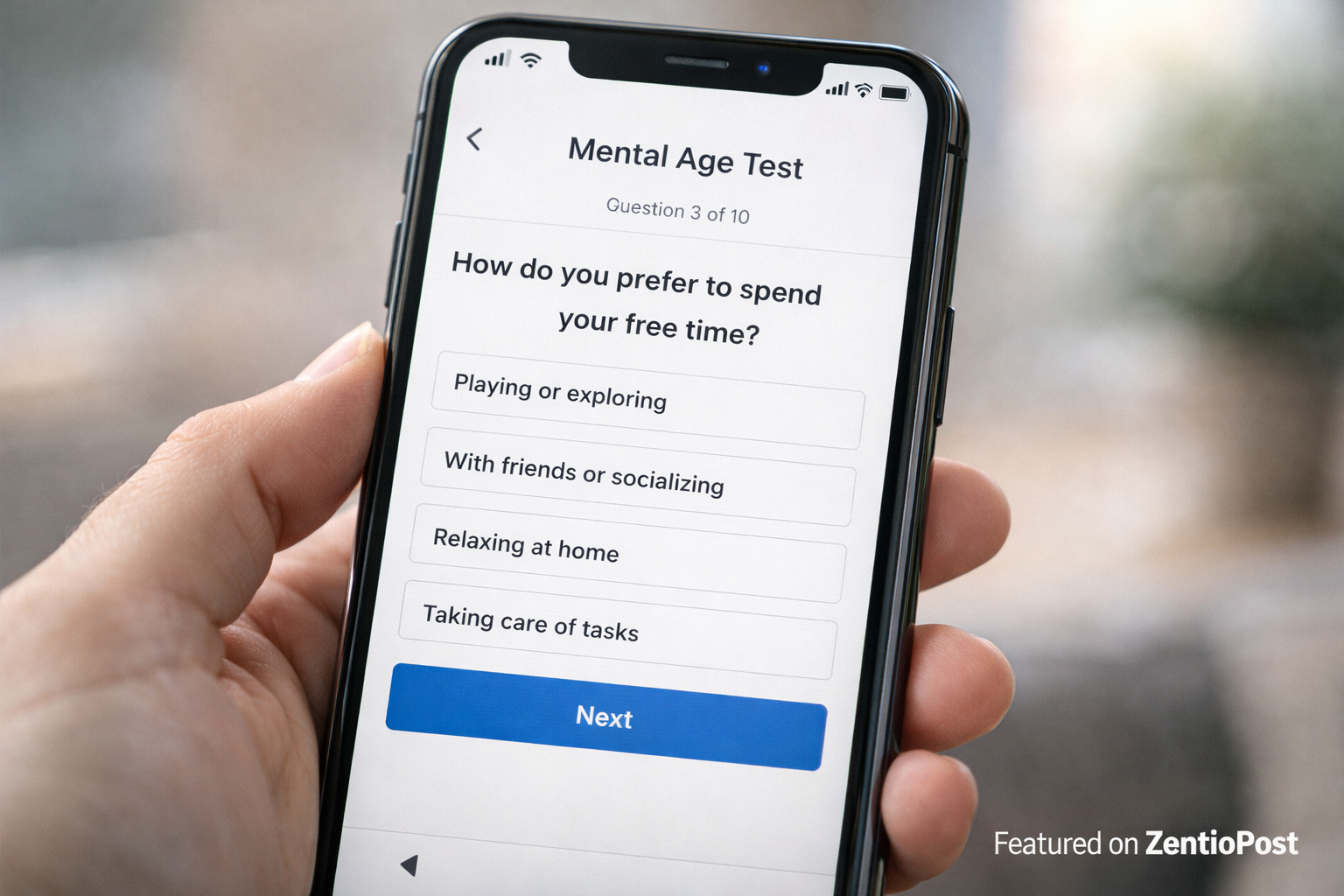
I remember the first time I took a mental age test. It was one of those late-night scroll moments. You know the kind. One click led to another, and suddenly I was answering questions about my habits, preferences, and how I spend my weekends.
A few minutes later, I got my result. It didn’t match my real age at all.
And that’s exactly why people love these tests.
There’s something oddly satisfying about seeing yourself through a different lens. But at the same time, it raises a question. What does a mental age test actually measure? Is there any real meaning behind it, or is it just entertainment?
Let’s break it down properly.
What Is a Mental Age Test?
A mental age test is a type of quiz designed to estimate your “mental age” based on your responses to certain questions.
Instead of asking how old you are, it looks at how you think, react, and behave.
These tests usually focus on areas like:
- Decision-making style
- Emotional responses
- Lifestyle habits
- Preferences (music, hobbies, routines)
- Social behavior
The result is a number that represents how “young” or “mature” your mindset appears.
For example, someone in their 30s might get a mental age of 22, while a teenager might score closer to 40.
That contrast is what makes it interesting.
How Mental Age Tests Work
Most mental age tests follow a simple structure. They ask a series of multiple-choice questions and assign values to your answers.
At the end, those values are combined to produce a result.
Here’s a basic idea of how the process works:
Step-by-Step Breakdown
- You answer personality-based questions
These often include everyday scenarios like how you spend free time or react to stress. - Each answer carries a score.
Some answers reflect a more “youthful” mindset, while others suggest maturity. - The system calculates your result
Your total score is mapped to a mental age range. - You receive a final number
This is presented as your “mental age.”
Simple, right?
But the simplicity is also where things get a bit tricky.
Why People Take Mental Age Tests
Let’s be honest. Most people don’t take these tests for scientific accuracy.
They take them because they’re curious.
And curiosity comes from a few places.
1. Self-Discovery
People enjoy learning more about themselves. Even a light quiz can feel like a reflection.
2. Entertainment
These tests are quick, easy, and fun. Perfect for passing the time.
3. Social Sharing
Results often get shared with friends, which makes them more engaging.
4. Validation
Sometimes people want confirmation of how they already see themselves.
- “I knew I thought like an old soul.”
- “No wonder I still feel like a kid.”
It creates a moment of recognition.
What Your Mental Age Result Really Means
Here’s the part where it’s important to stay grounded.
A mental age test doesn’t measure intelligence. It doesn’t define your personality in a clinical sense either.
What it does reflect is a mix of:
- Your current mindset
- Your lifestyle choices
- Your emotional tendencies
- Your preferences
Think of it like a snapshot, not a full report.
Common Interpretations
- Lower mental age (younger mindset)
Often linked to creativity, spontaneity, and a relaxed attitude. - Higher mental age (older mindset)
Usually associated with responsibility, patience, and structure.
Neither is better than the other.
It’s just different ways of approaching life.
Are Mental Age Tests Accurate?
Short answer? Not really.
Longer answer? It depends on what you expect from them.
These tests are not based on strict psychological research in most cases. They don’t replace professional assessments.
However, that doesn’t mean they’re completely meaningless.
They can still highlight patterns in how you think.
What They Can Do
- Give insight into your habits
- Reflect your current mood or lifestyle
- Spark self-awareness
What They Can’t Do
- Diagnose personality traits
- Measure intelligence
- Predict behavior with accuracy
So, it’s best to treat them as a fun tool, not a final judgment.
The Psychology Behind Mental Age
Even though online tests are mostly casual, the idea of “mental age” has roots in psychology.
Traditionally, mental age was used in early intelligence testing to compare cognitive development with actual age.
But modern psychology has moved beyond that.
Today, experts focus more on:
- Emotional intelligence
- Cognitive flexibility
- Social behavior
- Life experience
In other words, your “mental age” isn’t a fixed number.
It changes over time.
Signs of a Younger vs Older Mindset
You don’t always need a test to get a sense of your mental age.
Sometimes, your daily habits say a lot.
Traits of a Younger Mindset
- Enjoys spontaneity
- Adapts quickly to change
- Values fun and exploration
- Less focused on routine
Traits of an Older Mindset
- Prefers stability
- Thinks long-term
- Values responsibility
- More structured in daily life
Most people fall somewhere in between.
And that’s completely normal.
How to Use Your Results in a Practical Way
If you’ve already taken a mental age test, don’t just look at the number and move on.
Use it as a starting point.
A Few Simple Ideas
- Reflect on whether the result feels accurate
- Notice patterns in your daily behavior
- Think about what you might want to change
For example:
If your result suggests a younger mindset, you might already be good at staying flexible and open.
If it leans older, you might excel in planning and consistency.
The goal isn’t to “fix” anything. It’s just awareness.
Why Mental Age Can Change Over Time
One thing people don’t realize is that mental age isn’t fixed.
It shifts depending on life circumstances.
A few factors that influence it:
- Life experiences
- Career responsibilities
- Relationships
- Stress levels
- Personal growth
Someone might feel carefree at one stage and more serious at another.
That doesn’t mean they’ve changed completely. It just means they’ve adapted.
The Fun Side of Mental Age Tests
At the end of the day, these tests are meant to be enjoyable.
There’s no pressure. No right or wrong answer.
Sometimes it’s just about taking a break and seeing yourself from a different angle.
I’ve seen people take the same test twice and get completely different results.
And honestly, that’s part of the charm.
Frequently Asked Questions (FAQ)
What is a mental age test?
A mental age test is a quiz that estimates your mindset age based on your responses to personality and lifestyle questions.
Is a mental age test accurate?
Most online tests are for entertainment and not scientifically accurate, though they may reflect general behavioral patterns.
Can your mental age change?
Yes, mental age can change over time depending on life experiences, habits, and personal growth.
What does it mean if my mental age is lower than my real age?
It often suggests a more playful, creative, or relaxed mindset rather than immaturity.
What does a higher mental age indicate?
It typically reflects a more structured, responsible, and thoughtful approach to life.
Are mental age tests based on psychology?
The concept exists in psychology, but most online versions are simplified and not clinical tools.
Final Thoughts
Mental age tests sit somewhere between curiosity and entertainment.
They’re not something you should take too seriously, but they’re also not completely pointless.
Sometimes, they just give you a small moment to pause and think.
To notice how you approach life. How you react. What you value.
And in a world where everything moves fast, even that small moment can be worth it.
Also Read: ZENTIOPOST
