

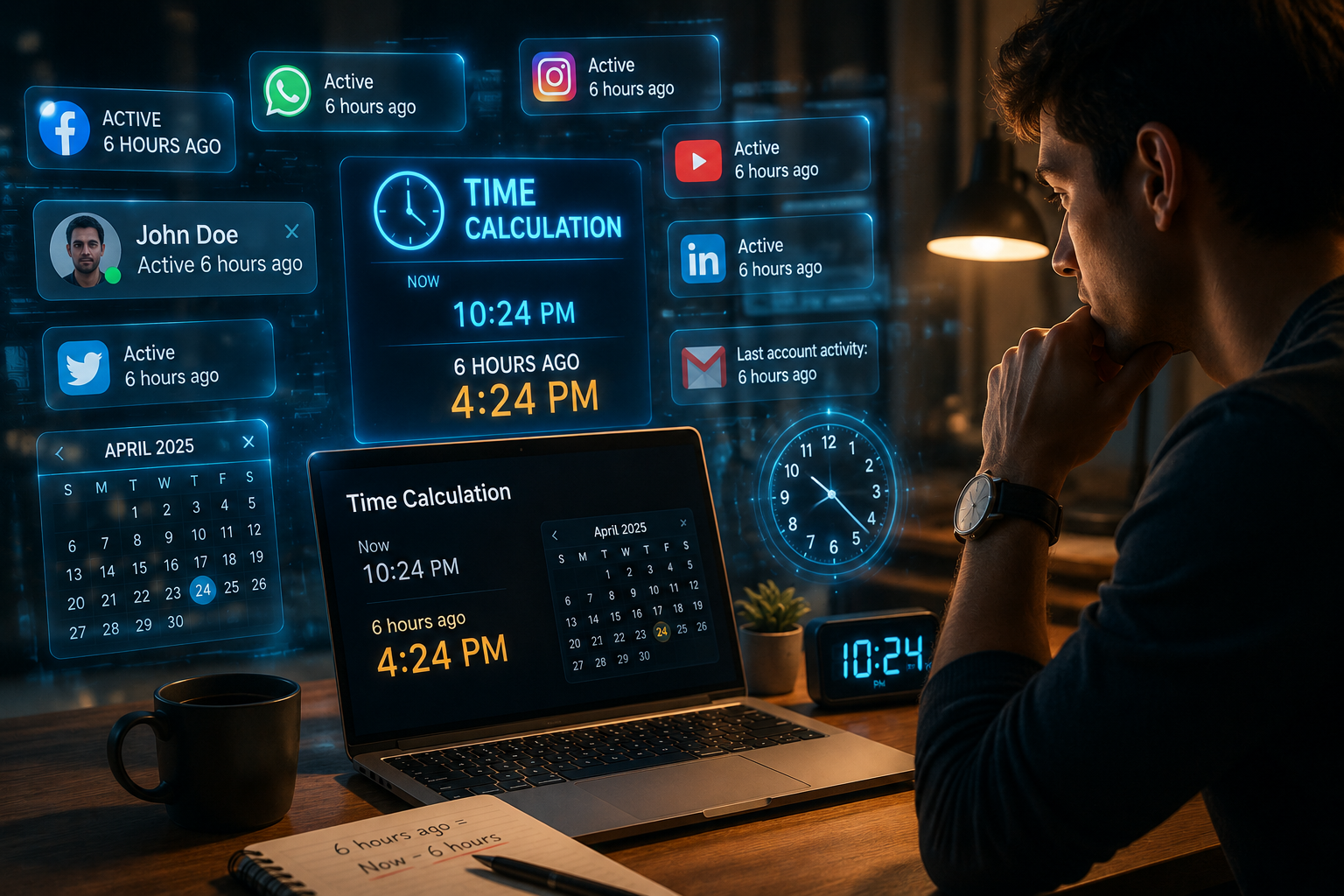
At first glance, “What time was it 6 hours ago?” sounds like one of those tiny internet questions you search quickly and forget five seconds later. But honestly, I’ve noticed this simple question pops up more often than expected.
Maybe you woke up from a nap and lost track of time. Maybe you’re trying to remember when you sent a message. Maybe your favorite streamer said, “I started 6 hours ago,” and now you’re doing mental gymnastics at 2 AM.
Been there.
The funny thing is that time calculations seem easy… until your brain suddenly stops cooperating. Especially late at night. Especially before coffee.
In this blog post, we’ll break down exactly how to calculate what time it was 6 hours ago, why people search this so often, how to avoid common mistakes, and a few surprisingly helpful tricks that make time math easier in everyday life.
And yes, we’ll keep it casual and human, not like a robotic math textbook pretending to be friendly.
Why People Search “What Time Was It 6 Hours Ago?”
I used to think only students doing homework searched for questions like this. Turns out, almost everyone does.
You’d be surprised how often this comes up in normal life:
- Checking when you fell asleep
- Tracking medicine schedules
- Remembering work shifts
- Gaming sessions that went way too long
- Social media post timing
- Fitness routines
- International calls
- Cooking or fasting schedules
- Exam timing confusion
- “Wait… when did I eat last?”
Honestly, modern life runs on weird little time calculations.
And unlike basic math, time calculations can get messy because clocks wrap around after 12 or 24 hours. Your brain suddenly starts buffering like slow Wi-Fi.
The Simple Answer: How to Calculate 6 Hours Ago
Here’s the easiest method:
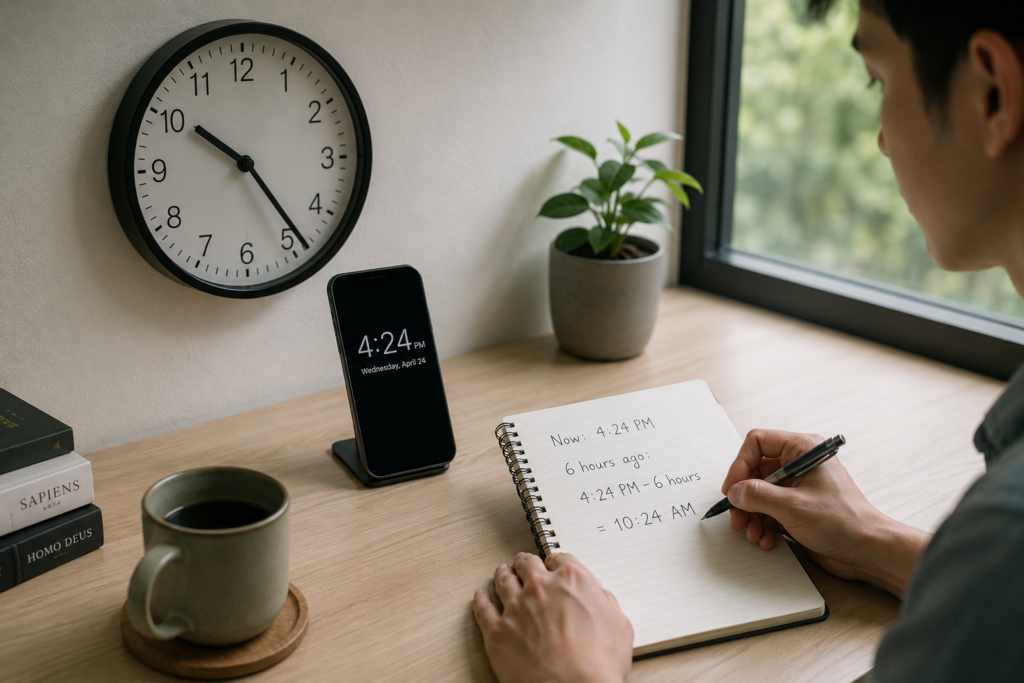
Current Time – 6 Hours = The Answer
That’s it.
If it’s currently:
- 10:00 PM, then 6 hours ago was 4:00 PM
- 7:30 AM, then 6 hours ago was 1:30 AM
- 12:00 midnight, then 6 hours ago was 6:00 PM
Simple in theory.
But once AM and PM enter the chat, people suddenly lose confidence. I do too sometimes.
A Quick Mental Trick I Use
Here’s the method I personally use because it feels less confusing.
Instead of subtracting 6 directly, I mentally walk backward in chunks.
Example:
Current time: 9 PM
- Back 3 hours → 6 PM
- Back another 3 hours → 3 PM
Done.
This chunk method works surprisingly well when you’re tired or distracted.
Another trick:
Use Clock Symmetry
6 hours is exactly half a clock cycle on a 12-hour clock.
So:
- 2 PM → 8 AM
- 11 PM → 5 PM
- 6 AM → 12 AM
Once you notice the pattern, calculations become faster.
Why Time Math Feels Weird Sometimes
Let’s be honest. Human brains were not designed for perfect clock math.
Numbers are linear.
Time is circular.
That’s why:
- 1 hour after 11 PM becomes 12 AM
- Midnight confuses everyone
- AM/PM switches feel awkward
- 24-hour format scares some people for no reason
I still occasionally pause for a second when converting military time.
“Okay… 18:00… yes, that’s 6 PM. Calm down.”
Common Situations Where This Helps
1. Sleep Tracking
This is probably the biggest one.
You wake up randomly and think:
“Wait… what time did I fall asleep?”
If it’s 8 AM and you slept 6 hours ago, then you crashed around 2 AM.
Which explains why your sleep schedule now resembles a confused raccoon.
2. Medicine Reminders
A lot of medications are taken every 6 hours.
That means people constantly calculate:
- When was the last dose?
- When is the next one?
- Did I already take it?
In situations like this, accuracy matters.
A simple phone timer honestly saves lives and stress.
3. Gaming and Streaming
Gamers absolutely know this struggle.
You start playing “for 30 minutes.”
Suddenly:
- the sun disappears,
- Your snacks are gone,
- And somehow it’s been 6 hours.
You check the clock like:
“There’s no way.”
There is a way.
There is always a way.
4. International Time Zones
If you have friends online or work remotely, you probably calculate time differences constantly.
Someone says:
“I was online 6 hours ago.”
Now you’re converting:
- their timezone,
- your timezone,
- daylight savings,
- and somehow questioning reality itself.
Global communication is amazing, but also mildly exhausting.
How to Calculate 6 Hours Ago Without Mistakes
Here’s a cleaner step-by-step system.
Step 1: Look at the Current Hour
Example:
Current time = 3:45 PM
Step 2: Subtract 6
3 minus 6 = negative territory.
So wrap backward around the clock.
3 PM → 9 AM
Step 3: Keep the Minutes the Same
45 minutes stays 45 minutes.
Answer:
9:45 AM
That’s the key detail people forget.
Usually, only the hour changes.
AM and PM: The Part That Trips Everyone Up
Here’s the easiest way to think about it.
Subtracting 6 hours often flips AM/PM.
Examples:
- 8 PM → 2 PM
- 4 AM → 10 PM
- 12 PM → 6 AM
The switch happens because you crossed midday or midnight.
No shame if this confuses you sometimes. Time formatting is oddly unintuitive.
The Internet Made Time Questions More Common
Years ago, people probably asked friends or checked wall clocks.
Now we constantly think about time online.
YouTube:
- “Uploaded 6 hours ago.”
Instagram:
- “Active 6 hours ago.”
Discord:
- “Last seen 6 hours ago.”
News websites:
- “Updated 6 hours ago.”
And suddenly everyone becomes a part-time mathematician.
Why We’re Weirdly Obsessed With Time
This might sound deep for a simple clock question, but hear me out.
People don’t just track time because they need information.
We track time because we’re trying to understand our lives.
- Did I waste today?
- How long was I productive?
- How long have I been awake?
- When did things change?
- How much time passed?
Even simple searches like “what time was it 6 hours ago” connect to memory, routines, and daily structure.
That’s probably why these tiny searches happen millions of times.
Best Tools for Quick Time Calculations
If mental math isn’t your thing, there are easy tools.
Smartphone Clock App
Most phones let you:
- add hours,
- subtract hours,
- set timers,
- Check world clocks.
Honestly underrated.
Google Search
You can literally type:
“What time was it 6 hours ago?”
And search engines calculate instantly.
Convenient? Absolutely.
Lazy? Maybe slightly.
But efficient wins.
Voice Assistants
You can ask:
- Siri
- Google Assistant
- Alexa
And get instant answers.
We are officially living in the future.
A slightly chaotic future, but still.
Time Zones Make Everything More Complicated
If you’ve ever talked to someone internationally, you know the pain.
Example:
- You live in Pakistan
- Your friend lives in New York
- They say they were active 6 hours ago
Now your brain starts loading:
- current local time,
- UTC differences,
- daylight savings changes,
- possible mistakes.
At that point, many people simply give up and send:
“You awake?”
Probably the smarter strategy.
The 24-Hour Clock Trick
Here’s something that helps a lot.
Use 24-hour format.
Examples:
- 18:00 = 6 PM
- 04:00 = 4 AM
- 23:00 = 11 PM
Subtracting becomes easier.
Example:
22:00 – 6 hours = 16:00
That’s cleaner than:
10 PM – 6 = uh… 4 PM… wait yes.
Airlines, hospitals, and military systems use 24-hour time for a reason.
Less confusion.
Everyday Examples of “6 Hours Ago”
Let’s do a few practical examples.
| Current Time | 6 Hours Ago |
| 6:00 AM | 12:00 AM |
| 8:00 AM | 2:00 AM |
| 12:00 PM | 6:00 AM |
| 3:00 PM | 9:00 AM |
| 7:00 PM | 1:00 PM |
| 11:00 PM | 5:00 PM |
Simple once you see patterns.
Why People Forget Time So Easily
Honestly, modern schedules are chaotic.
Notifications, social media, streaming, work, gaming, school,everything blends.
Sometimes six hours pass in what feels like:
- 20 minutes,
- or three business years.
There is no in-between.
That’s why tiny searches about time have become surprisingly popular online.
People constantly need quick orientation.
A Funny Personal Experience
One time, I took an “accidental nap” at around 5 PM.
You already know where this is going.
I woke up at 11 PM completely disoriented.
Dark room.
Silent house.
Phone brightness at maximum attack level.
I genuinely thought it was morning for about two full minutes.
Then I searched:
“What time was it 6 hours ago?”
Because my brain temporarily stopped functioning.
That moment alone convinced me these searches are more universal than people admit.
Time Calculators vs Mental Math
Which is better?
Honestly:
- Mental math is faster for simple calculations
- Online tools are safer for accuracy
Especially when:
- time zones matter,
- work schedules matter,
- medication timing matters,
- Travel plans matter.
No trophy exists for doing math manually.
Use whatever works.
SEO and Online Trends Around Time Questions
This type of search has become huge because people want instant answers.
Search phrases like:
- “What time was it 6 hours ago?”
- “What was the time 6 hours back?”
- “6 hours before now.”
- “time calculator”
…are all extremely common.
Why?
Because they solve an immediate problem quickly.
And honestly, quick-answer searches dominate modern internet behavior.
Nobody wants to open a calculator app for basic clock subtraction if Google can do it instantly.
How Different Cultures View Time
This is a fun side note.
Some cultures are very clock-focused.
Others are more flexible with time.
You’ve probably heard jokes like:
- “I’ll be there in 5 minutes.”
- which secretly means 30 minutes.
Time is technically universal, but humans interpret it very differently.
And yes, this absolutely causes chaos in group plans.
The Psychology of Counting Backward
Here’s something interesting.
Humans are generally better at counting forward than backward.
Forward feels natural:
- 1, 2, 3, 4…
Backward requires more attention:
- especially with wraparound systems like clocks.
That’s why:
“What time will it be in 6 hours?”
Often feels easier than:
“What time was it 6 hours ago?”
Tiny psychological difference. Big mental effect.
Easy Ways to Improve Time Awareness
If you frequently lose track of time, a few habits genuinely help.
Use Timers
Simple but effective.
Especially for:
- studying,
- gaming,
- naps,
- workouts.
Keep a Consistent Sleep Schedule
Your brain tracks time better when routines stay stable.
Not always easy, though.
Especially during exams or binge-watching sessions.
Use World Clock Features
Helpful for:
- online friends,
- remote work,
- international gaming,
- content creators.
Technology Changed Our Relationship With Time
Before smartphones, people relied on:
- watches,
- wall clocks,
- TV schedules,
- routines.
Now time is everywhere constantly.
Your devices track:
- activity,
- sleep,
- screen time,
- location,
- workouts,
- reminders.
We’re more aware of time than ever… yet somehow still late sometimes.
Impressive, honestly.
Quick Formula to Remember
Here’s the simplest summary possible.
Current Time – 6 Hours = Time 6 Hours Ago
If subtraction goes below zero:
- wrap around the clock.
Examples:
- 2 AM → 8 PM
- 1 PM → 7 AM
- 9 PM → 3 PM
Once you practice a few times, it becomes automatic.
FAQs About “What Time Was It 6 Hours Ago?”
How do I quickly calculate what time it was 6 hours ago?
Subtract 6 from the current hour while keeping the minutes the same. If you go below zero, wrap around the clock.
Does subtracting 6 hours change AM and PM?
Often yes. Crossing noon or midnight flips AM/PM.
What if I use a 24-hour clock?
It becomes easier. Example:
18:00 minus 6 hours = 12:00.
Why do people search “what time was it 6 hours ago” so much?
Usually, for sleep tracking, social media timestamps, gaming sessions, medicine schedules, or time zone conversions.
Are online time calculators accurate?
Yes, especially for basic calculations. They’re helpful when dealing with multiple time zones or daylight savings.
What time was it 6 hours ago from midnight?
If it’s currently 12:00 AM, then 6 hours ago was 6:00 PM.
Is there an easy mental trick?
Yes. Move backward in 3-hour chunks twice. It’s often easier than subtracting 6 directly.
Final Thoughts
It’s funny how such a tiny question, “What time was it 6 hours ago?” can connect to so many parts of everyday life.
Sleep schedules.
Gaming marathons.
Work routines.
Late-night confusion.
International conversations.
Random internet curiosity.
And while the calculation itself is simple, the reason we ask usually isn’t.
Sometimes we’re tracking productivity.
Sometimes we’re organizing life.
Sometimes we just woke up from a nap and forgot what year it is.
No judgment.
At the end of the day, time calculations are one of those small digital-age habits we all rely on constantly without really noticing.
And honestly? Anything that helps make daily life a little less confusing is probably worth knowing.
